Social Procurement: It Can Be Done

A new instalment of Impact Stories, developed in collaboration with VITA.it, dedicated to exploring experiences and trajectories of social impact.


How can purchasing power become a tool for generating social impact?

The latest Impact Stories article looks at the work Torino Social Impact is carrying out on social procurement, through two pilot pathways aimed respectively at public administrations and private companies.

On the public side, the work focuses on exploring the use of social clauses and impact criteria in procurement procedures. In the private sector, three companies are testing new models of collaboration between for-profit and non-profit organisations, with the aim of supporting the inclusion of social enterprises in supply chains.

A shift from awareness-raising to concrete experimentation, to understand how purchasing and supply chains can become levers capable of combining competitiveness, collaboration and social impact.

Read Daria Capitani’s article on VITA

PROSECO: European Exchange on the Social Economy and Socially Responsible Public Procurement in Iași

On October 7 and 8, 2026, the consortium of the Interreg Europe PROSECO project met in Iași, Romania, for the project’s third interregional meeting, hosted by ADV Romania. Two days dedicated to exchanging experiences among European partners and local stakeholders, with the aim of exploring policies and tools to support the social economy and socially responsible public procurement.

The meeting provided an opportunity to learn more about experiences developed in Romania, review the progress of project activities and discuss strategies that can foster the development of social enterprises at regional level.


An Integrated Ecosystem Supporting Social Enterprises

The first day began with a visit to the AFIN – ADV Group – SFA social economy ecosystem, a model combining business development, inclusive employment, market access and social finance tools. The experience offered an opportunity to reflect on the value of collaboration between support services, financing and market opportunities in fostering the sustainable growth of social enterprises.

Project Updates and Next Steps

During the Steering Committee, partners shared the lessons learned during the first three semesters of PROSECO, reviewed the progress of activities and discussed the next stages of the project, with a focus on communication and dissemination activities and planning for the following semesters.

Torino Social Impact presented the activities carried out so far in the Turin area together with the City of Turin, as well as the next steps planned for the coming months.

Socially Responsible Public Procurement: Comparing Experiences

On October 8, at Iași City Hall, the Policy Exchange Seminar brought together representatives of local and regional institutions and European experts to explore the role of public policies in promoting the social economy and socially responsible public procurement.

Participants included Roxana Necula, Deputy Mayor of the Municipality of Iași, and Ioana Danila, Councillor of the Iași County Council, alongside representatives from other European organisations.

Ioannis Pergantas, Vice-President for Social Welfare of the Region of Central Greece, presented the Greek experience in responsible and social procurement, focusing on the transition from the opportunities provided by the regulatory framework to their implementation at regional level.

Mieke Frans, from the Province of Flemish Brabant, and Caroline van Campen, from the Municipality of Amsterdam, explored the main developments in the reform of the European public procurement framework and their implications for contracting authorities.

The discussion brought different approaches and experiences into dialogue, highlighting the opportunities offered by public procurement to support social enterprises and integrate social objectives into local development policies.

The day continued with a series of study visits, which gave partners the opportunity to learn about local organisations translating social impact into concrete activities and services.

Strengthening European Cooperation for a More Inclusive Economy

The third interregional meeting of PROSECO confirmed the value of transnational exchange as a tool for sharing practices, comparing intervention models and identifying new opportunities for collaboration.

The exchange between territories highlighted how public policies and socially responsible procurement can complement each other in creating more favourable conditions for the development of social impact organisations and for building more inclusive and sustainable regional economies.

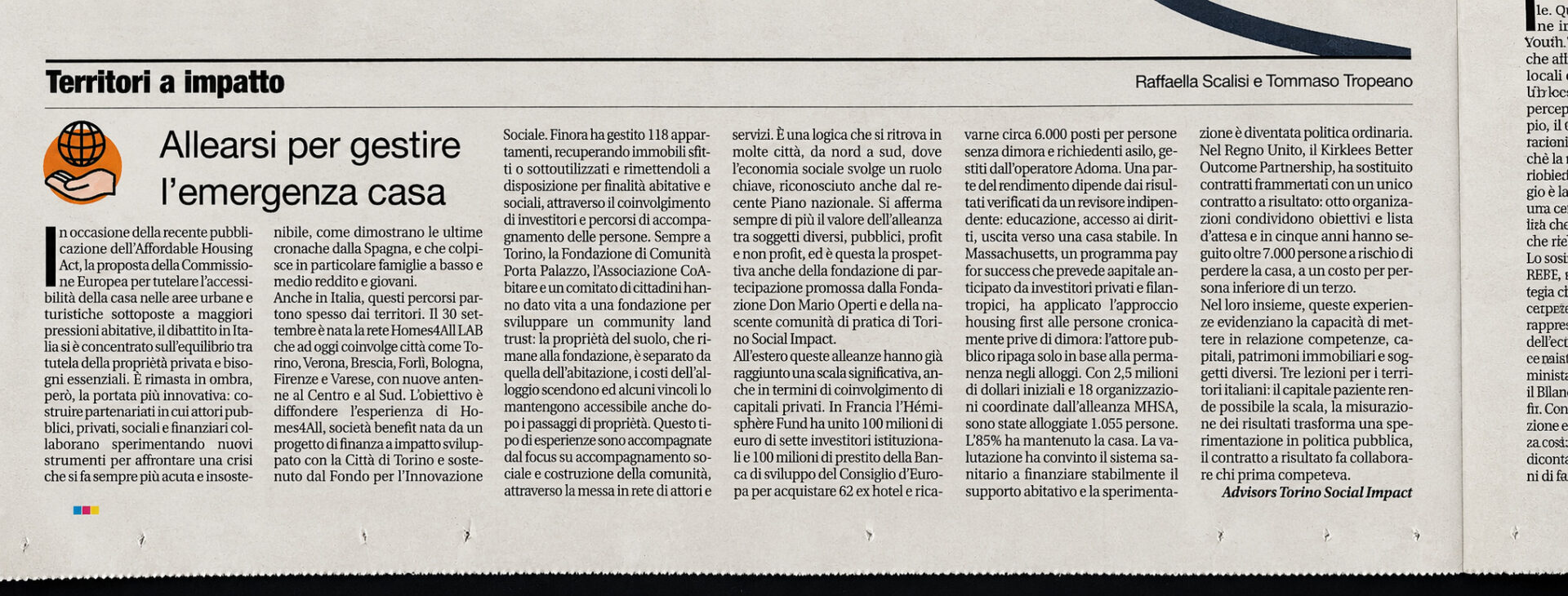
Impact Territories: Multi-Stakeholder Alliances to Address the Housing Emergency

The second instalment of Impact Territories explores housing affordability and the role of collaboration between public, private, social and financial actors in developing new responses to the housing crisis.


Impact Territories continues, the column published in L’Economia Civile, the fortnightly supplement of Avvenire, and curated by Torino Social Impact Advisors Raffaella Scalisi and Tommaso Tropeano. The column examines some of the major economic and social transformations taking place today, starting from local experiences and new forms of collaboration between different actors.

Following the first instalment, which introduced the pathway and perspective of the column, the second article, entitled “Joining Forces to Address the Housing Emergency”, focuses on housing affordability, an increasingly pressing issue for cities that particularly affects young people and low- and middle-income households.

Starting from the recent publication of the Affordable Housing Act, the European Commission proposal aimed at improving housing affordability in urban and tourist areas experiencing the greatest housing pressures, the article shifts attention to an aspect of the debate that has so far received less consideration: the possibility of building partnerships between public, private, social and financial actors, capable of pooling resources, expertise and tools.

Among the Italian experiences featured is Homes4All LAB, the network launched on September 30 to spread the model developed by Homes4All. The network currently involves Turin, Verona, Brescia, Forlì, Bologna, Florence and Varese, with new local hubs also being developed in Central and Southern Italy.

The experience of Homes4All, a Benefit Corporation originating from an impact finance project developed with the City of Turin and supported by the Social Innovation Fund, shows how the recovery of vacant or underused properties can be combined with investor involvement and support pathways for residents. To date, the project has involved 118 apartments, bringing them back into use for housing and social purposes.

Also in Turin, the article highlights the experience of the Fondazione di Comunità Porta Palazzo, Associazione CoAbitare and a citizens’ committee working to develop a community land trust: a model that separates ownership of the land from ownership of the housing, with the aim of preserving affordability over time.

These different experiences share the ability to combine housing solutions with social support, community building and the creation of networks between actors and services. It is an approach in which the social economy can play a central role and which is also reflected in new forms of collaboration being developed across the Turin area.

Heimat Academy and CasaOz: Co-Design as the Starting Point for a New Educational Pathway

A body percussion and rhythm workshop for children and young people. But above all, a pathway built around meeting, listening and understanding the context.


Since October, Heimat Academy, the cultural division of Heimat Srl, has launched a new collaboration with CasaOz, a Turin-based organisation that supports children, young people and families through activities, relationships and spaces for everyday life. At the heart of the project is a workshop dedicated to body percussion, rhythm and music, designed as a space where the body, movement, voice and instruments can become opportunities for expression, listening and connection.

The first session has already provided an opportunity to begin getting to know the group, experiment with body sounds and explore percussion, starting also from music chosen directly by the young participants. But the pathway began even before entering the workshop space.

Designing After Meeting

One of the most significant aspects of the collaboration between Heimat Academy and CasaOz is the co-design process that preceded the start of the activities.

In educational work, objectives, tools and methods often have to be defined in advance, before the people taking part in the pathway are even known. In this case, it was possible to dedicate time to dialogue among professionals, to understanding the context and to gradually shaping the proposal.

This approach makes it possible to view the project as a structure that can evolve over time according to the people involved, the relationships that develop and the needs that emerge.

For Heimat Academy, this dimension is a fundamental part of educational work: designing with the organisations and people involved, rather than simply for them.

Music as a Space for Connection

Body percussion and rhythm thus become not only subjects to learn, but also tools through which to experiment with different forms of participation. The body is an instrument that everyone carries with them. A clap, a gesture, a sound or a beat can become part of a shared language in which each participant can find their own space.

The pathway will continue over the coming months and may also open up to dialogue with other artistic languages, while keeping at its core the possibility of progressively adapting activities to the group.

A New Pathway for Heimat Academy

The collaboration with CasaOz is part of the work that Heimat Academy is developing in the field of educational projects through music, theatre, movement, sport and awareness practices.

The aim is to develop initiatives in which artistic languages can become tools for fostering participation, expression and relationships, working together with organisations and professionals operating in different contexts.

During one of the sessions at CasaOz, a sentence printed on a T-shirt caught our attention:

“There’s no place as beautiful as home, but it takes courage to get there.”

It seemed to us a particularly fitting phrase to accompany the beginning of this new pathway.

Planet Smart City Wins the 2025 Italian Innovation Award for Social Impact with EnergyVista

Planet Smart City, together with partners Energy of Things, Midori Connect and NEAR Sgr, has received the Italian Innovation Award for the best social impact project of 2025 with EnergyVista, a solution developed within the European ProLight project and dedicated to the digital energy transition.


EnergyVista supports residents in monitoring and reducing energy consumption through intuitive visualisations, personalised notifications and practical recommendations. The project combined digital tools with a resident engagement pathway at Urbana New Living in Milan, a social housing initiative promoted by NEAR Sgr, through co-creation activities and Citizen Labs led by Planet Community Managers.

The approach delivered tangible results: over two years of monitoring, energy consumption decreased by 10%, understanding of energy bills increased by 35%, and 70% of participants remained actively engaged beyond the initial phase. The model, based on the integration of data, technology and the human dimension, was designed to be modular and replicable.

Planet Smart City is available to make this experience available to new projects, including funded programmes, by collaborating with institutions, companies and partnerships interested in developing more inclusive and participatory housing solutions.

Eviana Arduino Appointed Head of Business Services

From listening to companies to developing skills: a vision of training that responds to changes in the world of work.


Eviana Arduino, 36, is the new Head of Business Services at Enaip Piemonte. She succeeds Francesca Marcone, who has taken on the new role of Director of Operations – Innovation and Development. We would like to thank her for the work carried out over the years leading the Service and for her contribution to its growth and development.

The Business Services team coordinates and supports training activities for companies and their employees, working closely with the 16 Enaip Piemonte Centres across the region. Its activities are developed through a range of tools and opportunities: apprenticeships funded by Regione Piemonte and privately funded apprenticeships, Individual Continuing Training, Supply Chain Academies, and training financed through Interprofessional Funds, including Fondimpresa, Fondartigianato and Fondirigenti.

Eviana, who holds a degree in Management and Planning of Educational and Training Services, has worked at Enaip for eight years. Her professional path has developed within training services for companies, starting with the coordination and management of training plans and progressively expanding to the design, monitoring and management of increasingly complex projects. She has worked closely with companies, partners and funding bodies, developing particular expertise in the instruments made available by Regione Piemonte and the Interprofessional Funds.

How do you feel about taking on this new professional role?

I see this new role as the next stage of a journey that began at Enaip Piemonte eight years ago. During this time, I have grown professionally thanks to the experiences I have had the opportunity to undertake, the responsibilities gradually entrusted to me and, above all, the exchange with colleagues from whom I have learned a great deal.

Taking responsibility for Business Services today represents an important opportunity for me, which I approach with enthusiasm and a strong sense of responsibility. It means coordinating a team, but above all supporting colleagues across our centres, valuing the skills and experience that enable Enaip every day to respond to the training needs of companies throughout the region.

It is also a role that feels particularly close to my own understanding of training. I strongly believe in lifelong learning and in the possibility, at any age and at any stage of one’s career, to update skills, take on new challenges and continue to grow both professionally and personally.

For me, training is not only a response to changes in the labour market: it is a concrete tool through which people can invest in their professional future.

What do you think will be the biggest challenges?

I believe one of the main challenges is keeping pace with a rapidly changing world of work while, at the same time, helping companies and workers understand that continuously updating skills is no longer optional, but a fundamental part of any professional journey.

For us, this means being able to listen to what is happening within companies and local communities, identify needs that are constantly evolving, and turn them into genuinely useful training opportunities.

There is also an internal challenge that I consider equally important: building increasingly strong collaboration between Business Services and the Enaip centres. Colleagues working across Piedmont are our day-to-day point of contact with companies and have first-hand knowledge of their needs, characteristics and transformations. My role is to support them, facilitate their work and connect the experience and expertise available across the network.

The real challenge is therefore twofold: supporting companies through change while, at the same time, building an increasingly connected Enaip network capable of responding to that change together.

What are the key points of your development project? What would you like to achieve?

I would like Business Services to become increasingly effective as a connecting point between our centres, companies and the training opportunities available, capable not only of making the most of continuing training opportunities, but also of helping local areas invest consistently in strengthening and developing skills.

To learn, unlearn what is no longer enough, and learn again.

For me, this is one of the great challenges of our time. Skills change, work evolves, and people need the opportunity to evolve alongside it, regardless of their age or stage in their career.

In this sense, I feel very close to the role of Enaip Piemonte: supporting people not only as they enter the world of work, but throughout their professional journey, offering opportunities to update their skills, grow and invest in their future.

Bench-Mark | Ep. 114 – La Luna del Grano

Motherhood is not an interruption in a professional journey, but a transition that companies, managers and individuals can learn to approach differently.

In this episode of Bench-Mark, Sonia Zappitelli, co-founder of La Luna del Grano, explains how the benefit corporation supports organizations through a cultural shift aimed at embracing parenthood and reducing the number of new mothers leaving the workforce.

Born in part from its founder’s own experience of motherhood, La Luna del Grano works with parents and managers before, during and after the transition to parenthood, helping to reshape the way it is experienced and perceived within organizations.

Because social impact can also be seen in a new mother returning to work without fearing that her career will be penalized, a new father feeling free to fully experience parenthood, and policies and certifications translating into tangible, lasting change.

Interview by Francesco Antonioli.

Filmed and edited by Riccardo Quaglio.

Watch all past episodes of Bench-Mark here.

Impact Measurement for Benefit Corporations: Practical Tools and Methods

An afternoon dedicated to exploring the role of impact assessment and measurement for Benefit Corporations, with a focus on different methodologies and practical tools: this was the theme of the latest Fit4Benefit meeting.


Hosted by Va Lentino srl SB at Imbarchino, the session brought together 14 organisations for a training and peer-exchange activity focused on impact.

Led by Amapola and Mercato Circolare, the meeting is part of the broader Benefit Corporations Community of Practice, developed in collaboration with Unione Industriali Torino and co-designed with the Benefit Corporations Amapola, BDFL Torino STP SB, Futura Law Firm and Mercato Circolare, with the support of the Torino Chamber of Commerce and the Compagnia di San Paolo Foundation.

Following the opening remarks by Torino Social Impact, delivered by Lorena Di Maria, Nadia Lambiase from Mercato Circolare engaged participants with a guiding question: “What keyword comes to mind when you think about impact?”

The discussion started from one word: change.

Impact can be defined as the social, environmental or economic change generated by an organisation, activity, project or intervention. Understanding it therefore means going beyond simply measuring the activities carried out and examining the effects generated over time on people, communities and the local area.

From this perspective, impact assessment can become a driver of continuous improvement and innovation, providing data and evidence to support decision-making and the development of new solutions. It can also strengthen dialogue with stakeholders and build trust, supporting impact communication based on concrete evidence.

This led to a second key point shared during the session: there is no single best methodology for impact assessment.

As Anna Filippucci from Amapola highlighted, the choice of tool depends on the purpose of the assessment, what is being analysed, the data available, the stakeholders to be involved and the organisation’s level of maturity.

The question to ask is therefore not “what is the best method?”, but rather “what is the most appropriate method for this specific case?”.

Participants were then introduced to a range of impact assessment methods and approaches: from narrative approaches and the Theory of Change to SROI, the B Impact Assessment and the Common Good Matrix.

The aim was to illustrate the variety of tools available and the importance of choosing a methodology that reflects each organisation’s specific needs, while also considering the possibility of combining different approaches and drawing on their respective strengths.

Amapola then presented an impact assessment experience carried out in 2025 using the SROI methodology. The case provided an opportunity to explore the process followed, the reasons behind the choice of methodology, how it was applied and the lessons learned.

The methodological discussion was also translated into practice through a workshop activity. Working in groups, the organisations compared the methodologies and assessment tools used in their own experiences, sharing strengths and critical issues. A set of common prompts guided the exchange, encouraging comparison between different approaches and peer learning, before a final plenary discussion.

The discussion then moved to a broader question: how can the value generated by an organisation be defined?

This question highlighted the need for a cultural shift capable of recognising forms of value that cannot be fully translated into monetary terms. A particularly significant reflection for Benefit Corporations, which are called upon to bring together economic, social and environmental dimensions.