

The second instalment of Impact Territories explores housing affordability and the role of collaboration between public, private, social and financial actors in developing new responses to the housing crisis.
Impact Territories continues, the column published in L’Economia Civile, the fortnightly supplement of Avvenire, and curated by Torino Social Impact Advisors Raffaella Scalisi and Tommaso Tropeano. The column examines some of the major economic and social transformations taking place today, starting from local experiences and new forms of collaboration between different actors.
Following the first instalment, which introduced the pathway and perspective of the column, the second article, entitled “Joining Forces to Address the Housing Emergency”, focuses on housing affordability, an increasingly pressing issue for cities that particularly affects young people and low- and middle-income households.
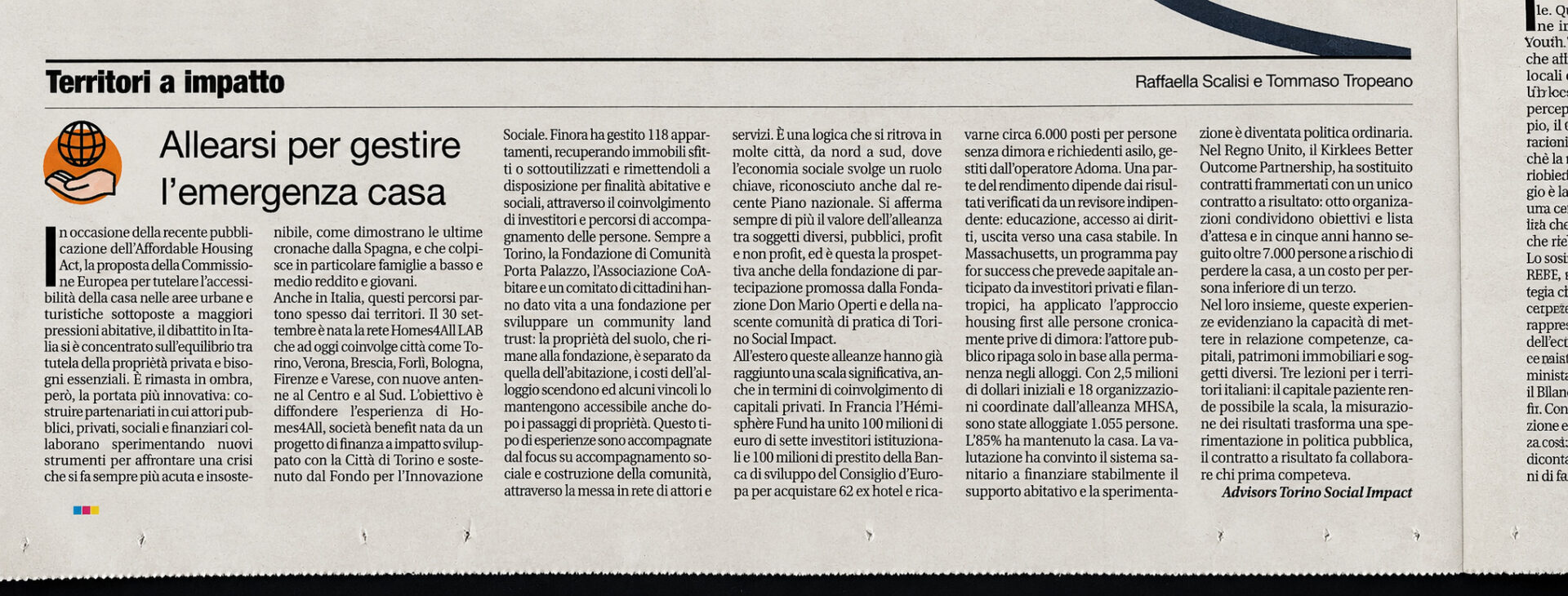
Starting from the recent publication of the Affordable Housing Act, the European Commission proposal aimed at improving housing affordability in urban and tourist areas experiencing the greatest housing pressures, the article shifts attention to an aspect of the debate that has so far received less consideration: the possibility of building partnerships between public, private, social and financial actors, capable of pooling resources, expertise and tools.
Among the Italian experiences featured is Homes4All LAB, the network launched on September 30 to spread the model developed by Homes4All. The network currently involves Turin, Verona, Brescia, Forlì, Bologna, Florence and Varese, with new local hubs also being developed in Central and Southern Italy.
The experience of Homes4All, a Benefit Corporation originating from an impact finance project developed with the City of Turin and supported by the Social Innovation Fund, shows how the recovery of vacant or underused properties can be combined with investor involvement and support pathways for residents. To date, the project has involved 118 apartments, bringing them back into use for housing and social purposes.
Also in Turin, the article highlights the experience of the Fondazione di Comunità Porta Palazzo, Associazione CoAbitare and a citizens’ committee working to develop a community land trust: a model that separates ownership of the land from ownership of the housing, with the aim of preserving affordability over time.
These different experiences share the ability to combine housing solutions with social support, community building and the creation of networks between actors and services. It is an approach in which the social economy can play a central role and which is also reflected in new forms of collaboration being developed across the Turin area.
Popular


