SME Digitalisation Voucher 2026: Aggregated Projects for Companies in the Torino Social Impact Network

Piedmont-based social enterprises planning a digital investment can apply for a non-repayable grant of up to €25,000 per company through the SME Digitalisation Voucher 2026, provided they meet the requirements set out in the call. Aggregated projects are also among the available participation options: Fondazione Piemonte Innova, a partner of Torino Social Impact, is developing projects that companies in the network can join.


The Voucher supports the purchase of digital technologies, goods and services. Consultancy and training activities linked to the investment may also be included, within the limits established by the call.

As an aggregating organisation, Fondazione Piemonte Innova supports companies in defining the project, preparing the application and managing the subsequent phases. For projects involving an aggregating organisation, the percentage of eligible expenses covered by the grant increases by 5 percentage points.

The aggregated projects are currently being developed. Companies interested in assessing whether their investment is eligible for the Voucher and in considering participation can write by October 1, 2026 to bandi@piemonteinnova.it.

More information about the call

October 15, 2026 – GIOVANI AL CENTRO Conference

On October 15, 2026, Fondazione Mamre ETS will organise the conference “Giovani al Centro MAMRE – Towards a Hybrid Sociocultural Space”, dedicated to the creation of a new space for young people in Turin’s Barriera di Milano neighbourhood. The event will open with institutional greetings from Stefano Lo Russo, Mayor of Turin.


The morning will be dedicated to presenting the design process, exploring the proposals developed and using virtual reality, alongside a discussion on experiences of hybrid spaces, sustainability and the project’s impact on the local area.

The Spazio Mamre Giovani project was created with the aim of developing a place for meeting, participation and opportunity, where younger generations can build skills, express themselves and contribute to the cultural and social life of the local community.

The process has involved young people, students, universities, schools, professionals, institutions, associations and local organisations. During the first half of 2026, the voices of 180 young people were collected, while 101 Architecture students developed 20 projects for the new space. Dialogue with local organisations also identified 50 possible activities.

In the afternoon, the process will continue with co-creation workshops coordinated by Urban Lab, focusing on activities, collaborations and the project’s next steps.

The event will provide an opportunity for dialogue and exchange, transforming the design work carried out so far into a new phase of collaboration, with the aim of building together a space capable of supporting young people’s autonomy and participation.

Save the date!

October 15, 2026, from 9:30 AM to 1:00 PM
Fondazione Mamre ETS – Piazzale Croce Rossa Italiana 185/A, Turin

Digital Sustainability: New Perspectives on Impact in the TSI Ecosystem

The first digital sustainability survey carried out by Sloweb APS together with the Torino Social Impact ecosystem has been completed: an initial assessment of the practices adopted by organisations within the network, whose results will be presented as part of Sloweb’s programme at Terra Madre Salone del Gusto 2026, dedicated to the responsible and sustainable use of digital technologies.


The series of events, taking place between September 24 and 27, represents an important step in the joint work of Sloweb APS and Slow Food, which was recently formalised through a Memorandum of Understanding aimed at promoting a digital culture aligned with the principles of sobriety, sustainability and responsibility through information, training and the dissemination of good practices.

A First Snapshot of the Ecosystem

The survey promoted by Sloweb explored several areas, from the management and end-of-life of devices to the choice of digital suppliers and services, from accessibility and data management to the use of artificial intelligence and the ways in which digital content is produced and consumed.

The results provide a multifaceted picture: alongside practices and areas of awareness that are already present, several fields emerge in which knowledge and capacity for action still need to be further developed. The survey was not designed to assess individual organisations, but to establish an initial shared baseline of awareness, identifying practices, needs and issues that will require further attention across the ecosystem.

The results will be presented on Friday, September 25, during the session “Sustainable Digital Transition for More Responsible and Resilient Companies – An Awareness-Building Pathway on the Impact of Digital Technologies and AI, with Testimonies from Local Companies.”

Also as part of Sloweb’s programme at Terra Madre, Torino Social Impact will take part on September 27, represented by its spokesperson Mario Calderini, in the third session of the Digital Ethics Forum, dedicated to “Good Local Practices in the Responsible Use of Digital Technologies by Associations and Institutions.”

Participation in the two events offers an opportunity to share the first evidence gathered within the ecosystem, while also outlining the initial steps of a pathway that Torino Social Impact intends to develop to support its ecosystem in building greater awareness of digital technology and adopting more sustainable approaches to the management of digital tools.

A Key Issue for the Social Economy

Digital sustainability is more relevant than ever as a lens through which to examine the relationship between innovation, responsibility and impact.

For Torino Social Impact, this first initiative represents a starting point for developing broader awareness of the issue and exploring the different dimensions connected to the use of digital technologies.

The aim is to progressively integrate digital sustainability into the impact policies of organisations and the territory, in line with the objectives of the Torino 2030 Metropolitan Social Economy Plan and with the broader challenge of combining economic development, sustainability and social inclusion.

View the full Sloweb programme at Terra Madre 2026 and register for the events.

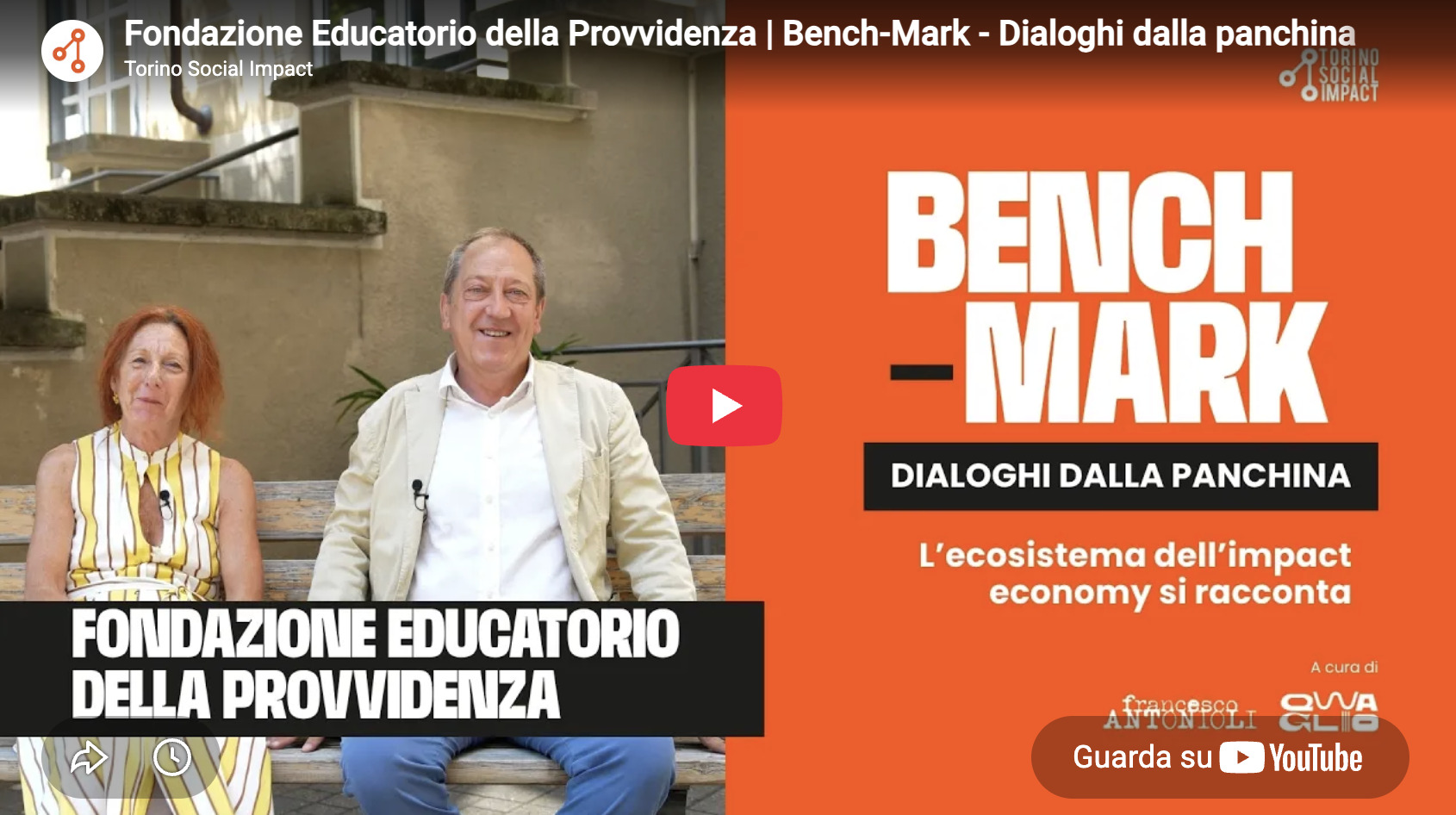
Bench-Mark | Ep. 113 – Fondazione Educatorio della Provvidenza

In this episode of Bench-Mark, we meet Fondazione Educatorio della Provvidenza, founded in Turin in 1722 and today committed to combining its philanthropic mission with new forms of social, educational and cultural intervention.

Its evolution and current work are explored through the perspectives of Carlo Majorino, President of the Foundation, and Paola Monaci, cognitive-behavioural psychologist and psychotherapist and Coordinator of Centro Psicotech Lab®.

The conversation brings together two complementary perspectives: on the one hand, how an institution with more than three centuries of history continues to rethink its role and approaches; on the other, the experimentation with psychotechnologies and new tools to support psychophysical well-being, prevention and care.

Interview by Francesco Antonioli.

Filmed and edited by Riccardo Quaglio.


Watch all past episodes of Bench-Mark here.

Slow Food Italia and Sloweb Sign a Memorandum of Understanding

Two movements, one common root. Digital sustainability enters the agenda of good, clean and fair food.


Slow Food Italia and Sloweb APS have signed a Memorandum of Understanding that brings the two movements together around a shared commitment: promoting a use of digital technology that is sober, clean and fair, starting from the agri-food sector.

The Memorandum is accompanied by long-term objectives and activities defined through 2030.

The first public event of the alliance will be Terra Madre Salone del Gusto, taking place in Turin from September 24 to 27, 2026, where Sloweb will be involved in a wide range of events dedicated to digital sustainability.

“For forty years, Slow Food has been raising awareness: about food, of course, but also about food production, biodiversity and more. We also need to raise awareness about digital technology, so that we are not overwhelmed by the power of tools that must remain at the service of humanity. We need digital education that enables us to make informed choices about how we feed our minds.” — Barbara Nappini, President of Slow Food Italia

“Over forty years, Slow Food has shown that it is possible to build a global movement starting from the concrete reality of everyday practices. We are doing the same with digital technology. This alliance gives us the network and legitimacy to do it at scale: we are ready.” — Mauro Bulgarini, President of Sloweb APS

The digital industry currently generates around 4% of global CO₂ emissions, a share higher than that of civil aviation and expected to grow with the spread of artificial intelligence. Every new smartphone has already generated 83 kg of CO₂ emissions before being switched on for the first time. Data centres worldwide consume as much electricity as entire countries, while artificial intelligence models require millions of litres of water to cool servers.

Meanwhile, the agricultural sector is under pressure from growing and unguided digitalisation: machinery that extracts data and cannot be repaired by farmers, platforms that create dependence on technology oligopolies, and digital traceability systems that often primarily benefit intermediaries.

Slow Food Italia and Sloweb share the belief that a digital transition not guided by sustainability criteria risks undermining the achievements of the agri-food movement. Good, clean and fair food can only be achieved through sober, clean and fair technologies and processes.

What the Memorandum Includes

The Memorandum of Understanding will remain in force for 24 months from the date of signing and may be renewed.

It defines several objectives.

Short-term objectives

  • Inform citizens, businesses and civil society about the real impacts of digital technology, using verifiable data and accessible language.
  • Educate through training programmes in schools, companies and Slow Food local chapters across Italy, including the Orto Digitale project.
  • Promote good digital sustainability practices, starting with the launch of the Sloweb Recipes at Terra Madre 2026.
  • Showcase companies and solutions working towards responsible digital technology, through a recognition system inspired by the Slow Food Presidia.

Medium-term objectives

  • Support applied research on digital sustainability in the agri-food sector, in collaboration with the University of Gastronomic Sciences of Pollenzo.
  • Integrate digital sustainability practices into companies within the Slow Food network through the Slow Digital Menu and self-assessment tools.

Terra Madre 2026: the First Testing Ground

The first public event of the alliance will be Terra Madre Salone del Gusto, taking place in Turin from September 24 to 28, 2026.

Sloweb will take part with a programme including a film series, performances and Slowlessons, including:

  • September 25: Corporate Training Event — an awareness-building pathway on the impact of digital technology for companies in the agri-food sector.
  • September 27: Digital Ethics Forum, sessions 3 and 4 — discussion and call to action on the relationship between digital technology and good, clean and fair food, involving local institutions and companies.
  • September 27: OCDR – Responsible Digital Consumption Observatory, with the participation of companies from North-West Italy.
  • September 28: Digital Pacts — agreements between families that help communities manage digital devices and services responsibly.

During Terra Madre, Sloweb Recipes. Recipes for a Healthier Digital Life will also be launched: ten practical recipes for a more conscious use of digital technology, distributed in HTML format and on postcards for the public.

Press contact • Slow Food
Slow Food Italia Press Office
press@slowfooditalia.it

Press contact • Sloweb
Pietro Jarre, Secretary of Sloweb APS
pietrojarre@sloweb.org

Impact Territories

Multi-stakeholder alliances to address social challenges. A column curated by Torino Social Impact for Avvenire’s Economia Civile supplement.


Impact Territories is the title of a monthly column that, starting in September, Torino Social Impact will curate in the pages of L’Economia Civile, the biweekly supplement of Avvenire.

This editorial project is based on the idea that local contexts are where innovative responses to ongoing social transformations can most effectively emerge and develop. It is at the territorial level that needs and vulnerabilities become more visible, and where social economy organisations operate most extensively, combining the creation of economic value with the pursuit of objectives of collective interest.

This local dimension becomes even more important in the face of the growing complexity of the challenges affecting European societies: difficulties in accessing housing, employment instability among younger generations, population ageing, migration, new forms of poverty and widening inequalities. These dynamics put social cohesion under pressure and can also contribute to weakening citizens’ trust in democratic institutions.

Torino Social Impact will therefore take readers on a journey through Italian and European territorial experiences that have developed innovative solutions and tools based on multi-stakeholder collaboration. Challenges of this complexity cannot be addressed through the isolated action of a single actor. It is therefore necessary to build forms of cooperation between public administrations, businesses, financial operators and Third Sector organisations, bringing together resources, expertise and capacity for action.

The first issue of the column, published on September 9 and written by Raffaella Scalisi and Tommaso Tropeano, mapped some of the countries most advanced in this field and the concrete tools developed through these multi-stakeholder partnerships, including social impact bonds, pay by results and outcome funds.

Starting with the next issue, on newsstands on October 7, the journey through Impact Territories will explore places where multi-stakeholder solutions are taking shape, dedicating each issue to a major social challenge: housing, NEETs, ageing, urban regeneration, labour inclusion and more.

The column will also highlight some of the most advanced Italian experiences, within a context that still shows a significant gap, mainly due to the limited presence of impact investors, weak administrative capacities, and the lack of shared metrics and a widespread culture of evaluation.

European Calls for Culture and Creativity in the Hub Webinar

On September 16, the European Projects Hub for the Social Economy organised a webinar dedicated to European funding opportunities for the cultural and creative sector, exploring three calls focused on artistic mobility, international cooperation and support for the Ukrainian cultural ecosystem.


During the meeting, three European opportunities of particular relevance to cultural and creative organisations were presented.

Perform Europe supports the cross-border circulation of performing arts works that have already been produced and are ready to tour, with a particular focus on sustainability, inclusion, diversity and climate action. The call provides grants ranging from €15,000 to €60,000 and requires a partnership of at least three organisations from three different Creative Europe countries.

ZMINA: Resilience focuses on strengthening and integrating the Ukrainian cultural and creative sector within the European landscape. The call supports co-creation projects between European and Ukrainian organisations, accompanied by activities for the public presentation of the works produced. Partnerships must involve at least two organisations from two Creative Europe countries, including at least one Ukrainian partner.

Culture Helps Solidarity aims to strengthen creativity, resilience and connections with communities in the Ukrainian context, during and after the war. The call supports individual grants, thematic projects and collaborations, complemented by mentoring, training, peer exchange, networking and the sharing of professional experiences and good practices. The programme also includes activities dedicated to intercultural dialogue, mental health support and the professional development of cultural managers.

The webinar provided an opportunity to explore the characteristics of the three calls, participation requirements, partnership structures and eligible activities, giving participating organisations useful elements to assess the possibility of developing and submitting their own project proposals.

Participants included Situazione Xplosiva APS, Rete Politecnica, Bottega di Cyrano – Teatro degli Acerbi, Al Cicapui ASD APS, Tedacà APS ETS, Itinerari Paralleli S.r.l., beeozanam ETS, Banca del Piemonte and Casa di Carità Arti e Mestieri.

The meeting also represents the first step towards accessing the free individual project development support pathway offered by the Hub: interested organisations can continue their work through tailored support dedicated to building and developing their project proposal.

The European Projects Hub for the Social Economy is an initiative developed in co-design with WECO Social Enterprise, with the support of the Torino Chamber of Commerce and the Compagnia di San Paolo Foundation.

OP4Impact: the Third Impact Capacity-Building Meeting

A new meeting for OP4Impact – Professional Orders for Impact: on September 17, at OFF TOPIC, the Community of Practice discussed skills, interprofessional collaboration and new pathways to support the social economy.


“Can culture be considered a genuine social infrastructure?” This was the question that opened the third meeting of the Impact Capacity-Building pathway of the OP4Impact Community of Practice – Professional Orders for Impact.

The pathway brings together the Order of Chartered Accountants and Accounting Experts of Turin, the Turin Bar Association, the Notarial Council of Turin and Pinerolo and the Order of Labour Consultants of Turin. It was created to respond to the needs of the social economy and to continue building, through an interprofessional approach, visions and actions capable of generating concrete impact.

The meeting focused on the experience of OFF TOPIC and its evolution from an association into a social enterprise: not simply a testimony, but a genuine case study of a cultural organisation that has succeeded in establishing strong roots in the local area, evolving its organisational model and generating new social and cultural outcomes. An experience that can also offer a valuable reference for other local organisations.

Ottavia Arenella, Project Manager at OFF TOPIC, presented the pathway, guiding participants through an experience in which culture, young people, territory and economic activities coexist within a single context. Founded as a cultural space and becoming a second-level association in 2018, OFF TOPIC is today a model in which value does not lie in a single event, but in maintaining a space that remains open, creates relationships and builds opportunities for youth participation.

Over the years, however, the organisation’s growth has raised new questions. In October 2025, OFF TOPIC underwent a transition from a social promotion association to a limited liability social enterprise. This change did not alter the organisation’s purpose, but required a rethink of how work is organised and decision-making processes are structured.

A particularly valuable aspect of this transition is that the process of amending the organisation’s statutes was supported by two professionals who are members of the Community of Practice. This provides a concrete example of how complementary professional expertise can serve as a lever for social economy organisations, contributing to the development of integrated governance and management models oriented towards generating and assessing social impact.

Among the challenges currently facing OFF TOPIC are the need to reduce precarious employment in the cultural sector, consolidate its organisational structure and define increasingly effective ways to measure and communicate the impact generated by its activities. These issues concern both the economic and social dimensions and make it essential to identify indicators capable of reflecting the complexity of the value produced.

It was precisely on this ground that the OFF TOPIC case opened up a broader reflection on the role of professionals in the social economy. As emerged during the discussion, the expertise of an individual professional is not enough: different skills need to converge, communicate through shared languages and move in the same direction.

From here, a discussion led by Caterina Soldi focused on governance and on the need to experiment with more participatory and collaborative models, in which decisions are the result of an integrated process. This perspective is particularly relevant for younger generations, who increasingly see work as a space in which to build their future while contributing to the wellbeing of the community.

The Theory of Change was the focus of the workshop aimed at activating the impact assessment strategy for Professionals for the Social Economy. The discussion helped clarify the connection between activities, outputs, expected changes and impact, bringing out a shared perspective: impact is not an additional dimension, but a lens through which strategies, governance, skills and relationships can be rethought.

In this direction, the pathway aims to build an interprofessional approach to the social economy, enhancing skills, cases and experiences and transforming them into new opportunities for collaboration and innovation. The objectives that emerged include strengthening skills and networking, integrating new approaches to the social economy and increasing awareness of the impact generated.

The next meeting of the Community of Practice will be open to the public: on Friday, September 25, as part of Terra Madre Salone del Gusto, the event “Social Economy: Feeding the Future with New Integrated Visions” will take place.

On this occasion, the “Professionals for the Social Economy” pathway will be presented. Developed within OP4Impact, it will consist of six training seminars accredited by the Professional Orders and dedicated to exploring the potential of the social economy through the complementarity of professional skills.

For more information on the programme and registration, please visit the following link.

Professional Mobility and Local Impact: Heimat Srl Launches “Montevecchio

Heimat Srl is expanding its hospitality services in Turin with Montevecchio, a new accommodation solution designed in particular for companies and professionals who need to stay in Turin for medium- to long-term periods.


The apartment is located in the city centre, conveniently positioned for both central Turin and Porta Nuova railway station. The solution was developed in response to increasingly common needs related to professional mobility: employees on business trips, temporary staff working in the city, consultants, researchers and people involved in local projects.

Montevecchio is a recently renovated 67-square-metre attic apartment on the fifth floor, with lift access. It features two single beds that can be joined together, a kitchen, a bathroom with walk-in shower, air conditioning, fibre Wi-Fi and utilities already active.

A Temporary Home, Without Starting from Scratch

The aim is to offer organisations a simple solution to manage, including for stays lasting several weeks or months. For this reason, Heimat Srl offers packages that can include utilities, internet connection and corporate invoicing, with solutions tailored to the duration and specific needs of each stay.

Montevecchio complements the other accommodation solution managed by Heimat Srl in Turin, which is mainly dedicated to shorter stays, allowing the company to respond to different needs for temporary accommodation in the city.

Hospitality and the Local Area

For Heimat Srl, hospitality is not simply about managing a living space, but is one of the areas through which the company develops services connected to people and the local community.

Alongside its educational, cultural and communication activities, the hospitality area aims to make arriving and staying in Turin easier for people travelling for work, training, projects and collaborations.

Companies, institutions and organisations looking for accommodation solutions for staff on business trips can visit the dedicated Montevecchio page.

For information, availability and customised requests: heimat.locazioni@gmail.com

From Courses to Internships: Enaip Piemonte Connects Training and Work

The social impact storytelling developed in collaboration with Futura News continues — the outlet of the Master in Journalism of Turin, offering a perspective on the Torino Social Impact ecosystem through the work of young journalists.


The new article in Visione Futura tells the story of the work carried out by Enaip Piemonte, one of the leading training agencies in the area, committed to supporting young people, adults, people looking for employment and those undergoing professional reskilling towards new job placement opportunities.

From the voices gathered in the article, a model emerges that brings together training, guidance and employment services. From vocational courses to individual interviews, from CV review to dialogue with companies and the activation of internships, Enaip Piemonte builds pathways capable of bringing skills closer to labour market needs, placing people at the centre and turning training into a concrete step towards work.

Read the article on Futura News

A Bit of [hi]story

From September 30 to October 4, 2026, Turin will host the sixth edition of A Bit of [hi]story, the free festival organised by the Piedmontese Computer Science Museum – MuPIn. In the year of its fifteenth anniversary, the museum presents “Digital Balances: the Real Costs of Computing”, a journey through the history of computers, artificial intelligence and sustainability.


On Saturday, October 3 and Sunday, October 4, the festival will open to the public at Docks Dora, Via Valprato 68, with talks, exhibitions and opportunities for dialogue for enthusiasts, families and curious visitors. Topics will include the role of supercomputers in weather forecasting, the history of Apple and Olivetti, the environmental impact of digital technologies, the right to repair and the contribution of women to computer science.

Guests over the weekend will include Luca Mercalli, Guido Saracco, Gastone Garziera, Giorgio Garuzzo, Fabio “Kenobit” Bortolotti, don Luca Peyron and Ugo Vallauri. On Saturday evening, there will also be a DJ set by Kenobit and a mini Kick-Off tournament. The opening is scheduled for Saturday, October 3 at 10:30 AM in the Cingomma space.

From September 30 to October 2, activities will be dedicated to schools at the Metropolitan City of Turin headquarters, Corso Inghilterra 7. Conferences and workshops will address digital security, algorithms, cryptography, fake news and new perspectives on AI, with a contribution by mathematician Olivia Caramello on topos theory.

Participation is free. To organise class attendance: eventi@mupin.it.

Programme and updates: www.abitofhistory.org

Gen[TI] – A Generation of Talents. An Opportunity for New Enterprises, Startups and SMEs

Gen[TI] – A Generation of Talents offers new enterprises, startups and SMEs in the Piedmont ecosystem the opportunity to host young talents through a 4-month paid internship covered by the project.


Who Can Participate

New enterprises, startups and innovative SMEs* with an operational headquarters in Piedmont can apply.

If you want to connect with motivated and highly qualified talents who can actively contribute to the development of projects, technological challenges and business growth pathways, this is an opportunity for your company.

*Please read carefully the Eligibility Requirements in the Call for Companies and/or in the FAQs available on the website.

What We Offer to Companies

  • Full financial coverage of four months of extracurricular internship
  • Facilitation of the match between talents and companies
  • Administrative support for the activation of the internship
  • Up to 40 hours of training and mentoring for talents on the development of professional, entrepreneurial and AI skills
  • Certification for talents of the skills acquired
  • Booster for companies: tailored support by Réseau Entreprendre Piemonte
  • GenTI Pass for companies: training on AI, ecosystem discovery experience and corporate matchmaking

When

  • The call is open on a rolling basis from July 29, 2026 to January 31, 2027
  • Internships will be activated in two time windows: the first approximately between October/November 2026, the second between February/March 2027

How to Apply

Applications, internship opportunities and the matching process between talents and host companies will be managed through the GenTI platform.

Information Webinar

Register here to take part in the introductory webinar, which will be held on September 23 at 4:00 PM.

The webinar is addressed both to young talents and to companies interested in taking part in GenTI.

Find Out More

Contact Réseau Entreprendre Piemonte for information or clarifications:

Gen[TI] is an experimental project promoted by the Compagnia di San Paolo Foundation and implemented by Réseau Entreprendre Piemonte, together with technical partners EnAIP Piemonte, Fondazione LINKS and University of Turin.

Amapola Publishes “Untangling the Thread”, Its 2025 Impact Report

19 community projects and 1,044 hours dedicated to benefit activities. The new document adopts the VSME as a reference and integrates a Social Impact Assessment for the first time.


“Untangling the Thread” is the title of the 2025 Impact Report by Amapola, the consultancy company specialised in sustainability since 2009 and part of the Torino Social Impact network.

The concept chosen for this edition is that of warp and weft. It is an image that recalls, on the one hand, the need to interpret a phase marked by growing economic, social and environmental complexity and, on the other, the way in which Amapola understands impact generation: as the result of the interweaving of people, projects, relationships, decisions and skills.

The Report therefore tells the story of a year in which the company continued to grow its activities and projects, while also working to make its path as a Benefit Company clearer, more structured and more measurable.

The Main 2025 Figures

In 2025, Amapola dedicated a total of 1,044 hours to benefit activities, carrying out 19 community projects. In its consultancy work, it collaborated with 97 clients and reached the cumulative milestone of 240 sustainability reports produced.

A central part of the pathway concerns the people in the team. During the year, an average of 45 hours of training per person was provided, while flexibility and smart working policies continued, with 933 days worked remotely.

At the same time, the company strengthened its commitment to gender equity and work-life balance, through already consolidated measures, such as the extension of parental leave, and new initiatives introduced in 2025. These include the Blind CV, designed to make selection processes more equitable, and the Caregiver Bonus, which provides additional leave for those carrying out care activities.

The improvement pathway continues beyond the reporting period. After obtaining the EcoVadis Silver Medal in 2025, in 2026 Amapola reached the Platinum level, the highest level in the rating system. This result recognises the progress made in recent years to make sustainability policies, processes and tools more structured.

A More Readable and Measurable Impact

The focus on translating commitments into policies, initiatives and concrete results is accompanied by broader work on the way Amapola defines and measures its impact. One of the main developments described in the Report concerns the common benefit objectives, which have been reduced from eleven to five.

“We chose to concentrate our objectives not to reduce our commitment, but to make it clearer and more effective. After several years as a Benefit Company, we felt the need to take a step forward: to define more readable priorities, better connect objectives, actions and results, and strengthen our ability to measure what we generate,” comments Luca Valpreda, Founder of Amapola.

Reporting is also evolving. For the second year, the Report uses the VSME, the European voluntary sustainability reporting standard for SMEs, as a reference, while maintaining its connection with the SDGs of the 2030 Agenda. This is accompanied by a further step in measurement: the first Social Impact Assessment carried out by Amapola, dedicated to the Meet the CSR Leaders initiative.

The project, created to foster dialogue between younger generations and sustainability professionals, will return with its fifth edition in October 2026 at the CSR and Social Innovation Fair. The Social Impact Assessment made it possible to complement the reporting of activities with a more in-depth reading of the effects generated by the initiative, testing an approach that Amapola intends to integrate increasingly into the design of its benefit activities.

Facing Complexity

“For us, being a Benefit Company means staying within complexity without looking for shortcuts,” state Anna Filippucci, Elisa De Bonis, Irene La Porta and Micol Burighel, members of the Amapola Impact Board. “Numbers are essential to guide our work, but not everything that generates value produces immediate effects. Some impacts become visible over time, when the different threads begin to reveal a pattern. This is why we continue to measure, learn and improve, holding together economic objectives and common benefit.”

“Untangling the Thread” therefore presents not only the results achieved in 2025, but also the way in which Amapola is progressively refining its tools, objectives and ability to assess its impact. Because, as the Report’s concept suggests, the pattern emerges precisely from the ability to recognise the different threads and understand how to hold them together.

The 2025 Impact Report by Amapola is available here.

Making Europe – Looking Further Ahead

How far can we look when we decide to do it together? On Tuesday, September 29, 2026, from 6:30 PM, Making Europe – Looking Further Ahead comes to the Mole Antonelliana for an event dedicated to space research and to the choices that help shape our present.


It starts from a little-known yet decisive story: that of Edoardo Amaldi and the birth of European space cooperation. The story will be told live by Lorenzo Pregliasco and Lorenzo Baravalle, in a special live and previously unreleased version of the podcast Making Europe.

It will also offer a preview of the theme at the heart of the episode, which will soon be released on all major listening platforms: a journey between history and the present to understand how scientific collaboration opened paths that we still follow today.

Bringing this story back into the present will be Caroladivù, with a contribution dedicated to what research and innovation mean today for younger generations.

But the audience will not simply be spectators. During the event, each participant will have a limited number of “mission credits” and will be asked to choose which priorities to allocate them to: from space research to climate, from health to science education.

The choices collected will contribute to the creation of the Constellation of Turin, a visual restitution by the artist Kalla, which will take shape starting from the audience’s input.

The event will be hosted by Carolina Sardelli, journalist at TgCom24.

The event will conclude with an informal networking moment in the spaces of the Mole Antonelliana. At the end of the event, participants will also have the opportunity to go up the Mole free of charge using the panoramic lift and look at Turin from above. A simple way to close the evening while continuing, quite literally, to look further ahead.

Accreditation link

Terra & Tech: Innovation, Experimentation and Results

Terra & Tech: Innovation, Experimentation and Results

First presented in 2023, Terra & Tech is the national open innovation programme for Italian viticulture, organised and promoted by the association Filiera Futura in collaboration with the Innovative Companies Incubator of Politecnico di Torino (I3P). Since its launch, the main objective of the initiative has been to identify the evolving needs of the wine sector through direct dialogue with the key actors in the supply chain, and to involve a selection of innovative startups capable of implementing technological solutions to support the wine industry.


After a series of discussion tables held in 2024 with the six banking foundations partnering in the programme — Fondazione CRC, Fondazione Cariverona, Fondazione Cassa di Risparmio di Lucca, Fondazione Carifac, Fondazione Cassa di Risparmio di Jesi and Fondazione con il Sud — and their networks of associated producers, in 2025 over 70 project proposals were collected through an international call for startups.

Among all applications, the 20 most promising solutions were selected and a series of field trials was launched — still ongoing in 2026 — across several Italian territories, to test the potential of the innovative technologies developed by the young companies.

The event scheduled for Thursday, September 24, 2026, from 10:00 AM, in person at the Sala Agorà of the I3P Incubator in Turin, will offer a feedback session on the results achieved by the programme. It will be an opportunity to publicly explore the opportunities for dialogue and improvement generated by Terra & Tech, the experiences developed by participating startups in producers’ vineyards, and the prospects for further development of the technological systems used, based on the data collected during the pilot tests.

The initiative is organised as part of Terra Madre Salone del Gusto 2026.

The event on September 24 will also be an opportunity to share the first previews of the second edition of the Terra & Tech programme, which will continue to grow through new activities focused on the concrete needs of producers, new research into the most disruptive technologies for the agri-food sector, and new innovation processes to be developed with and across Italian territories, for the benefit of all the actors involved.

How to Participate

The meeting with the promoters and protagonists of Terra & Tech will take place on Thursday, September 24, 2026, from 10:00 AM, in person at the Sala Agorà in the I3P Incubator headquarters, located inside the Politecnico di Torino Campus and accessible from the pedestrian entrances at Corso Castelfidardo 34 and Via Borsellino 53/N.

Participation in the event is free, upon registration on Eventbrite.

Programme

10:00 AM | Welcome and registration of participants in the room

  • Vincenzo La Forgia, Filiera Futura, Terra & Tech Project Manager

10:15 AM | Institutional greetings

  • Elena Giannini, Vice President of Filiera Futura
  • Paola Mogliotti, Director of I3P

10:30 AM | The first edition of Terra & Tech: objectives, phases and results achieved

  • Adriano Marconetto, Serial Entrepreneur and Business Angel
  • Riccardo Valpiani, Business Consultant at I3P

10:50 AM | Field trials by innovative startups

  • Testimonies from the young companies involved in the project

11:20 AM | Preview of the second edition of Terra & Tech

11:30 AM | Conclusions

Cultivating the Future – Work, Legality and Value in Agri-Food Supply Chains

Is it possible to build agri-food supply chains capable of placing social sustainability at the centre? This will be discussed at “Cultivating the Future – Work, Legality and Value in Agri-Food Supply Chains”, a conference organised and promoted by Filiera Futura and Fondazione CRC, in collaboration with technical partner Weco Srl Impresa Sociale.


The meeting will bring together professionals and researchers from the sector to discuss the main critical issues concerning working conditions in agricultural supply chains, while presenting concrete experiences, regulatory perspectives and future scenarios.

The event, held as part of Terra Madre Salone del Gusto 2026 by Slow Food Torino, will take place on September 23, starting at 2:30 PM, at the Corso di Campagna Amica Market – Casa Coldiretti, Corso Vittorio Emanuele II 50, Turin.

The event is free, with registration required. Places are limited.

More information

September 25, 2026 — OP4Impact Goes to Terra Madre!

On Friday, September 25, 2026, as part of Terra Madre Salone del Gusto 2026, the event “Social Economy: Feeding the Future with New Integrated Visions” will take place at the headquarters of the Order of Chartered Accountants and Accounting Experts of Turin.


The event will offer an opportunity for dialogue on what it means to “feed the future” through new visions for the territory, oriented towards the common good and social impact, starting from the Torino 2030 Metropolitan Social Economy Plan.

The event is promoted by the Order of Chartered Accountants and Accounting Experts of Turin, the Turin Bar Association, the Order of Labour Consultants of Turin, the Notarial Council of the United Districts of Turin and Pinerolo, the Turin Chamber of Commerce, Torino Social Impact and Cottino Social Impact Campus. For three years, these organisations have shared the pathway of the OP4Impact – Professional Orders for Impact Community of Practice, a space for dialogue among different areas of expertise to build an interprofessional approach to the social economy.

The meeting will launch the project “Professionals for the Social Economy 2030”, developed within OP4Impact with the unprecedented aim of creating a cycle of six accredited training seminars promoted by the Professional Orders, to jointly address the potential of the social economy through the complementarity of professional skills.

Where and when

Order of Chartered Accountants and Accounting Experts of Turin
Via Carlo Alberto 59, 10123 Turin

Friday, September 25, 2026
3:00 PM – 5:00 PM

Programme

3:00 PM — Opening remarks

  • Salvatore Regalbuto, President of the Order of Chartered Accountants and Accounting Experts of Turin
  • Guido Bolatto, Secretary General of the Turin Chamber of Commerce
  • Marta Messa, Secretary General of Fondazione Slow Food ETS
  • Paolo Di Croce, General Manager of Fondazione Slowfood ETS

3:30 PM — Feeding the future with new integrated visions

  • Barbara Nappini, President of Slow Food Italia
  • Serena Milano, Director of Slow Food Italia

4:00 PM — Professionals for the Social Economy. The OP4Impact experience: Manifesto, strategic objectives and new projects for the city

Opening and moderation:

  • Caterina Soldi, Cottino Social Impact Campus – OP4Impact Coordination

Speakers:

  • Davide Barberis, Chartered Accountant – Order of Chartered Accountants and Accounting Experts of Turin
  • Luca Furfaro, Secretary General – Fondazione Studi dei Consulenti del Lavoro di Torino
  • Luigi Gili, Lawyer – Turin Bar Association
  • Gabriele Gili, Notary – Notarial Council of the United Districts of Turin and Pinerolo

4:45 PM — Q&A and conclusions

Registration

The event is addressed to professionals from the promoting Professional Orders and to interested citizens.

For information and registration, please contact the Secretariat of the Order of Chartered Accountants and Accounting Experts of Turin: segreteria@odcec.torino.it